
Pergola: Get a free quote • Quick response
Pergola
Do you dream of creating a relaxing and inviting outdoor space on your terrace or in your garden? An elegant pergola could be the solution! With a pergola, you get a flexible and functional area that provides shade on hot days and shelter from the rain.
Here you’ll find answers to everything you need to know about pergolas – from costs and materials to height and possible permits. We’ll help you realize the dream of your perfect outdoor space and can provide you with a free, no-obligation quote from a supplier in your area.
UtvendigSolskjerming.no is free to use for anyone looking for a pergola.
Get a free quote for a pergola
Send us a short description of your wishes and needs, and we’ll help you find a suitable solar shading supplier for your particular job.
Your contact information will only be used in connection with the request. Your personal data will not be disclosed to unauthorized persons.
What is a pergola?
A pergola is a free-standing, open structure consisting of posts and beams. It can either have an open roof or be covered with a material that provides shade, such as wood, metal or fabric.
Pergolas are often used as an architectural element in gardens and on terraces to define an outdoor space, provide shade and create a welcoming atmosphere. They can stand alone or be attached to a wall of the house. Pergolas come in many different sizes and designs, from simple and modern to more ornate and classic.
They can also be used as a support for climbing plants that will create a natural and lush feel. A pergola is a great choice for those who want to create a functional and beautiful outdoor space.
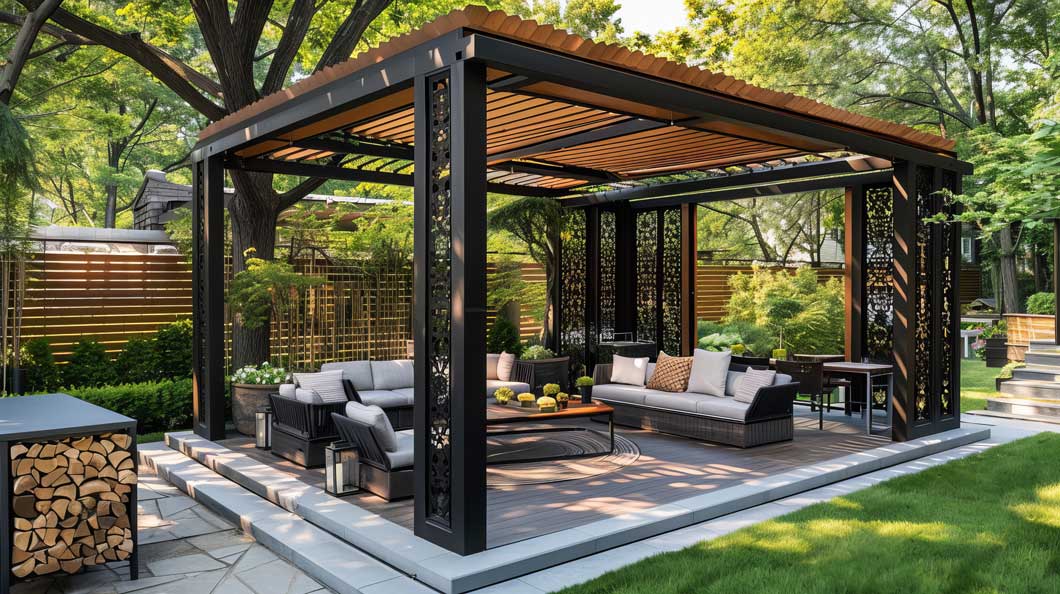
What does a pergola cost?
The price of a pergola can vary greatly depending on size, materials, design and any additional features. The most affordable variants can cost as little as NOK 5.000, while the more exclusive variants can cost as much as NOK 100.000 or more. Installation costs are additional.
A simple wooden pergola of decent quality usually costs from NOK 10.000 and up, while pergolas in maintenance-free materials such as aluminum usually start from around NOK 20.000.
One thing that will make a big difference to the price is how complex a design you want and what additional features you want. For example, you can choose to just buy the frame itself, which will be cheaper. If you want a pergola with a roof and integrated screening for one or more of the walls, the price will be considerably higher. If electrical work is required in connection with the installation of motorized solutions, this will also lead to increased costs.
If you want a high-quality pergola with a roof and various sun and wind shading solutions, you can expect to pay between NOK 70.000 and 120.000, all inclusive
What kind of roof should you have on a pergola?
There are many different solutions for pergola roofs. To begin with, it’s a good idea to get an overview of which roofing solutions are actually available.
Slatted roof
Adjustable aluminum or wooden slats provide flexible control of light and shade. These can be angled to let in more or less light as required. Aluminum slats are maintenance-free, while wooden slats need to be oiled or stained. These can withstand some snow, but not large amounts.
Folding roof
Folding roofs are usually supplied as motorized solutions. One of the biggest advantages of folding roofs is that the roof can be opened and closed completely. With a folding roof made of waterproof PVC fabric, you can also shut out the rain, so you can enjoy your pergola even on rainy days.
Pitched roof
Pitched roofs create a warm and cozy atmosphere. There are folding roofs that are suitable for pitched roofs, so you can retain the benefits of a folding roof. Pitched roofs can also be supplied as fixed panels in glass, plastic or metal. With the right dimensioning, these variants can also withstand some snowfall.
Pergola awning
A stable awning fabric that extends on rails at the sides and provides adjustable shade. The awning fabric can be replaced when needed. Available with manual or motorized control. Provides a lot of shade when extended. Should be rolled up during periods of high wind or snow.
Glass roof
Tempered glass mounted on a rail system or rubber strip provides a good view of the sky and lets in a lot of light. This gives a feeling of being closer to nature. Protects well against rain and snow. On sunny days it can get hot under the glass roof, but it is possible to install solar shading in addition.
Fixed roof
This is a permanent and robust solution where the roof is attached to the pergola. A fixed roof, on the other hand, offers less flexibility in that you can’t open and close the roof as you please. If you envision a conservatory or winter garden, a fixed roof would be a good solution.
Plastic roofs
Plastic roofs are usually a simpler and cheaper option, but they are also bad for the environment. Plastic is also less durable and will wear out faster. When the weather and wind take their toll on the material, it quickly becomes unattractive to look at.
What affects the price of a pergola?
-
Size:
The larger the pergola, the higher the cost of materials. -
Material:
Different materials have different prices. Wood such as larch, oak and kebony are cheaper than maintenance-free aluminum, but require more finishing. If you choose an exclusive type of wood such as teak, the price will be high. -
Design:
Simple, straight designs are more affordable than curved or more intricate constructions. Roof pitch and number of posts also affect the price. -
Additional features:
Automatic controls, built-in lights, heat lamps and retractable solar shading are examples of add-ons that increase the price of a pergola. -
Shipping costs:
If you’re ordering your pergola from a store or online shop, you’ll need to factor in additional shipping costs. -
Installation costs:
These costs vary depending on the scope of the job. -
Electrical work:
If you want motorized solutions, you may need to hire an electrician.
How high should a pergola be?
The height of a pergola depends on the area of use and the space it will be placed on.
The most common height is between 2.5 and 3.5 meters.
First you need to figure out how to make the pergola fit with the roof and structure of your house.
As a rule, you want the pergola to blend in, both in terms of size and appearance, so that it doesn’t stand out in a negative way.
Talk to a professional to find the optimum height of the pergola based on location, use and your wishes, so that it is exactly as you envision it.
Does building a pergola require a permit?
In principle, building a traditional pergola with a maximum size of 50 square meters does not require a permit. It is assumed that it is placed at least 4 meters from the neighboring border, and 1 meter from another building on the property. If the pergola is larger than 50 sqm, closer to the neighbor’s boundary or another building on the property, an application may be required.
The rules may vary somewhat from municipality to municipality based on local zoning plans. Therefore, always check with the municipality to confirm whether the measure you are planning requires an application or not. Any application must include dimensioned drawings, notification of neighbors and documentation that construction requirements have been met.
Can a pergola be left outside in winter?
Whether a pergola can be left outside in winter depends on the structure and the material it is made of. Suppliers of pergolas in Norway must consider the changing weather we have here, and not least the long winter, and therefore deliver solutions that can be left outside all year round.
A pergola made of pressure-impregnated or other treated wood, aluminum or steel can be left outside all year round provided it is correctly dimensioned and secured to withstand wind forces and snow loads. The roof must then be made of slats, panels or heavy-duty fabric that can withstand the amount of snow in the area.
A pergola with a roof made of ordinary awning fabric should be packed down for the winter. The fabric can be damaged by moisture, frost, snow and strong winds. The frame itself can be left outside if it is sturdy.
Untreated wood such as larch, oak and kebony can be left outside, but will then acquire a natural gray patina. Stain or paint will peel and require frequent maintenance.
No matter what type of pergola you have, it’s important to clear it of leaves and snow throughout the fall and winter to avoid rot or collapse due to excessive weight. In the spring, it should be thoroughly cleaned and any damage repaired.
Why should you build a pergola?
- Defines the outdoor space: A pergola is a great way to create a defined and functional outdoor space. It can form a pleasant dining area, a cozy seating area or a relaxing hammock nook.
- Provides shade: A pergola roof, whether it’s solid slats, fabric or a cover of climbing plants, provides much-needed shade on hot days. This allows you to enjoy your outdoor space even in the middle of the day when the sun is at its strongest.
- Shelter from rain: With a sturdy slatted or sheeted roof, the pergola also provides shelter from the rain. So you can sit outside, warm and dry, and enjoy the sound of the rain drumming on the roof.
- Design element: A pergola adds a new dimension and an eye-catcher to the garden. It can act as a portal between different zones in the garden or as a terrace divider. The design can be adapted to your home style, whether you want something modern, classic or rural.
- Support for climbing plants: The posts and beams of a pergola are perfect for climbing plants. A wall of wild vines, fragrant honeysuckle or colorful clematis creates a lush and romantic atmosphere.
- Privacy: Walls of fabric, plants or perforated sheets on the sides of the pergola provide more privacy on the terrace.
- Increases the value of your home: A quality pergola is an investment that enhances the entire outdoor space. This can increase the value of your home in the event of a sale.
How do I get a quote for a pergola?
To get a quote for a pergola, you can contact local suppliers and ask for a quote. This may sound simple, but it can prove to be quite time-consuming, as there are many things to research and find out in advance.
It’s important to choose a supplier with good experience, solid expertise and good references. A pergola is a long-term investment that needs to withstand the elements, so the quality of the product and craftsmanship should be in focus.
Our aim is to make the process of obtaining pergola quotes as easy as possible for you. We work with suppliers all over the country and can easily put you in touch with a qualified supplier in your area.
Fill in the form on our website and we will forward your enquiry to the professional in your area who is best suited to the job. Our service is free and non-binding, and you save time and energy by not having to contact and compare different suppliers yourself.